This site is protected by reCAPTCHA to prevent automated abuse. Device and interaction data is processed for security purposes in accordance with the School Fix Privacy Policy and Google's Privacy Policy.
Not every school lunchroom runs on traditional fold-and-roll cafeteria tables. High schools, university dining halls, and staff cafeterias increasingly want furniture that functions more like a commercial dining space: food court-style tables with fixed seating, bistro chairs, or café furniture that stays in place rather than folding and rolling between uses. This section covers that range: from traditional lunchroom chairs to modern food court seating configurations that make cafeterias feel less institutional and more inviting.
Three formats are available to fit different spaces and usage patterns:
Individual stack chairs and benches for use alongside folding cafeteria tables or fixed tables. Suitable for all grade levels. Available in plastic, padded, and metal designs.
Fixed-height table-and-seat combinations in round and square configurations, designed for high school dining areas, staff cafeterias, and university settings where furniture doesn't need to be stored away between uses.
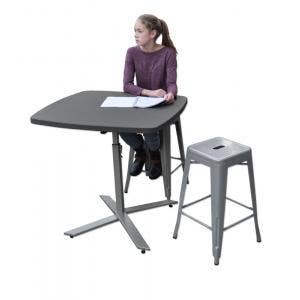
Contemporary café-style tables and chairs for schools that want a modern dining aesthetic. Well-suited for high school student lounges, library café areas, and smaller dining rooms.
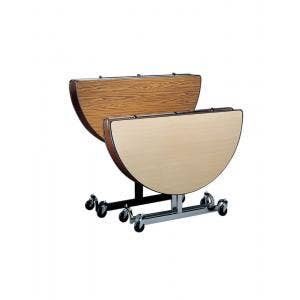
A school cafeteria's core furniture needs are: mobile folding tables (for flexibility in space use and storage), matched seating (stool tops, benches, or separate chairs depending on table style), and traffic control solutions for high-volume lunch periods. For spaces that double as event or meeting rooms, convertible bench units offer the best flexibility. For dedicated dining rooms that don't need reconfiguration, food court and café-style furniture provides a more permanent, comfortable setup.
What is the difference between cafeteria tables with stools and bench-style tables?
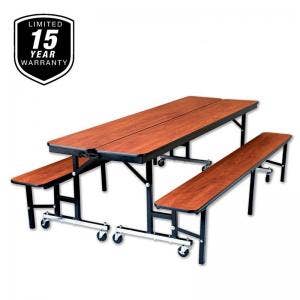
Stool-style tables have individually attached stools and are better suited for older students (middle and high school) who prefer individual seating and more legroom. Bench-style tables seat more students per table length: better for elementary schools where supervision and close seating are priorities, and for lunchrooms with high capacity demands. Convertible bench units give you both functions in a single product.
What cafeteria seating options work best for high schools?
High schools typically benefit from a mix of cafeteria tables: mobile tables for the main lunch rush (stool-style for older students, fold-and-roll for flexible space use), supplemented with food court or café-style fixed furniture in breakout areas or student commons. High school students tend to self-organize into smaller groups, so a variety of table sizes — round, square, and rectangular — creates a more natural dining environment than uniform rows of identical tables.
How much do school lunch tables cost?
Pricing varies significantly by brand, table size, seating style, and configuration. Convertible bench units typically start below $1,000 per unit. Full-size mobile stool-style cafeteria tables from brands like Virco, NPS, and KI generally range from $1,500 to $3,000+ depending on length, features, and quantity. For a complete lunchroom build-out or replacement project, request a quote. Our team can provide school district pricing and layout recommendations based on your room dimensions and capacity needs.
Are there cafeteria table repair parts available if my existing tables need fixing?
Yes. We stock replacement parts for most major cafeteria table brands, including stool top caps (the most common replacement), table tops and benches, T-mold edge strips, casters, and universal hardware. Repairing existing cafeteria tables rather than replacing them is almost always the more cost-effective choice when the table frame is intact. See our Replacement Cafeteria Table Parts section for parts by brand and type.