


Newsletter
Join the School Fix Community!
Better Products for Better School Maintenance.
- Exclusive Deals
- New Product Alerts
- Latest Industry News
- Maintenance Tips
Cart Subtotal :
You have no items in your shopping cart.
Subtotal:
x
You have no items in your quote.
Checkout using your account
This site is protected by reCAPTCHA to prevent automated abuse. Device and interaction data is processed for security purposes in accordance with the School Fix Privacy Policy and Google's Privacy Policy.
Checkout as a new customer
Creating an account has many benefits:
Purchasing new school cafeteria tables and lunchroom seating is a decision that requires a bit of thought. We hope that this comparison can assemble most of the facts together for you to take into consideration when you are trying to buy the best cafeteria table for your school.
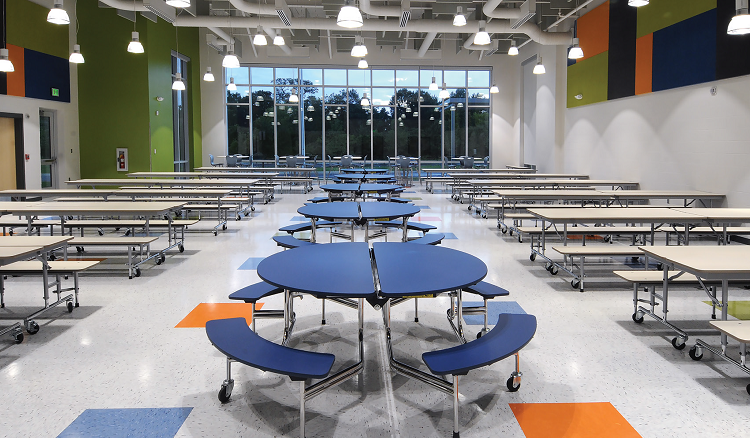

When trying to find the right cafeteria table for your school lunch room, it's vital to look at some of the obvious concerns like quality, ergonomic benefits of different styles, ease of use to make breaking down, folding, and storage easy, and of course, safety features and benefits of each design.
Choose from rectangular, round, and elliptical shape mobile folding table options to best fit into your specific school environment. Round or elliptical shapes can create a more collaborative space, while a more traditional rectangular shape can create a more defined cafeteria seating arrangement. Many schools choose a combination of round and rectangular tables to give options to have a different user arrangement. School Fix® can help in the design of your cafeteria layout in order to maximize seating capacity or enhance student collaboration.
Ease of setting up, breaking down, and rolling tables away to the storage location needs to be safe and manageable by utilizing minimal staff. The exact folding operation and function of mobile folding tables vary from table manufacturer to table manufacturer. A primary consideration when buying the best cafeteria table for your school should be the ease of folding up and down, with the assistance of a torsion bar or a hydraulic lift-assist mechanism to reduce potential staff member back strain.
Setting up and breaking down tables repeatedly can cause avoidable workplace stress or even injury. We have found that all of the mobile folding table manufacturers that we represent have reliable built-in lift assist mechanisms that significantly reduce user stress, such as mobile tables from KI, which feature pneumatic cylinders and a torsional energy storage system, ensuring safe and easy use. This is not always the case if using older tables. Older cafeteria tables can wear down lift assist mechanisms and often cannot be adequately repaired or made to function as a new cafeteria table functions. New tables are just simply more reliable and safe. Driving a car with 200,000 miles on it can be challenging. The same goes for mobile folding cafeteria tables. Repeated use over many years, folding and rolling away, plus general wear and tear in a school environment, can make tables unreliable. School Fix's recommendation is to replace those worn-out cafeteria tables with new tables that incorporate better engineering and are designed to meet today's safety and design standards.

Seating options for portable folding tables are best chosen based on the age of students that will most frequently be using the tables. The basic idea here is to allow older students a more defined and independent space, with stool-style seating, while younger students may be better placed on bench-style seating. There is no absolute rule here, but you should consider which style table best fits your school based on the age of your students.
Other popular options that should be considered are mobile folding tables with ADA access points and tables with a lower-than-standard height to more easily accommodate smaller children.

School Fix® represents the leading manufacturers of school cafeteria tables, including Krueger International or KI, National Public Seating, AmTab, Virco, and Biofit, all tables have a manufacturer warranty from ten to fifteen years to give you confidence that the table brand decision that you made will function reliably in your school for years.

Some of the most popular quality features and durability options can help your new tables operate as you expect and stay looking great in your school environment. Below, we have listed a few choices you should consider when buying new cafeteria tables.
Table Top and Bench Core Material Options:
1. MDF Core Material
2. Plywood Core Material
Table Frame and Undercarriage Tubing Finish:
1. Chrome Plated Steel
2. Powder Coated Steel
Table Top and Bench Edging Options:
1. Molded-In Heat Treated Edge
2. T-Molded Edge


Always top on the list of concerns, storage can be challenging, especially if mobile tables are being stored in an open area of the cafeteria or hallway. Today, portable folding tables are designed for compact storage while maintaining stability in an upright (folded) position. Modern locking safety latches hold tables secure and require the user to make a commitment to unlock the table to begin unfolding. Unfolding should be slow and safe. The same lift-assist mechanism also provides safe resistance to help the operator slowly expand the table and reduce any risk of the table unfolding too fast.
Review the operation of your tables often. If a table is not consistently operating correctly during the setup and breakdown process, do not continue to use that table. Honestly, it is not worth the risk. Here are a few common problems to watch out for:
1. Lift-assist mechanism if not lifting or providing resistance when setting up and breaking down.
2. Safety latch mechanism is not functioning properly or is not operational.
3. Table casters are not rolling properly or appear worn out.
4. Cafeteria table tops, benches, or stool tops are cracked and wobbly, especially if the stool top spins around and is not secured correctly to the frame tubing.
All of these points above should be checked and inspected as often as possible. Many of our School Fix® customers create a cafeteria table safety inspection checklist, with at least a weekly review of safety, operation, and functionality. Of course, if you ever need to replace anything on your cafeteria tables, School Fix has you covered with our Replacement Cafeteria Table Parts.


Customizable: Oval Tables are available in five colors with a Particleboard Core and Vinyl T-Molding Edge options. Offered in multiple color combinations.
Certified: Virco Mobile Tables are UL, BIFMA, GreenGuard, and CPSIA Certified, so you can be assured you are making a safe, smart decision.
Safety First: Tables are optimized for safe use featuring high-impact ABS Stool Caps, a specially designed Torsion Bar System, and heavy-duty 4” Casters. Folds in teepee position to prevent potential tipping.
Quality Assured: Tubular Steel Frame with high-impact ABS Stools and a laminated Particleboard Tabletop. Backed by a Limited 10-Year Warranty.
Spacious: Mobile Stool Style Tables allow students to have more personal space when seated versus Bench Style Cafeteria Tables.
Don't see a Virco table you are looking for? Find more here:


Don't see an NPS table you are looking for? Find more here:


Don't see a KI table you are looking for? Find more here:


Don't see an AmTab table you are looking for? Find more here:
Many school cafeteria and lunchroom seating solutions can be implemented into your facility’s plan, but if you’re on a tight budget and need cafeteria tables that are affordable and dependable, look no further than School Fix®. We also carry a vast inventory of Cafeteria Table Repair Parts to renovate worn-out cafeteria furniture. We hope you found this guide helpful. To read more about our products or solutions to common school maintenance concerns, please visit the School Fix® Blog.
1. What are school lunch tables called?
School lunch tables are commonly referred to as cafeteria tables, lunchroom tables, or mobile tables if the table has wheels.
2. What is the size of a lunchroom table?
The size of a lunchroom table may vary depending on the shape of the table. Standard rectangular cafeteria tables generally measure around 120"-144" in Length x 30" in Width x 29" in Height. Standard round cafeteria tables generally measure 27"-29" in Height x 60" in Diameter.
3. What are cafeteria tables made of?
Cafeteria tables are generally found with three different core materials. MDF Core, Particleboard Core, or Plywood Core with a high-pressure laminate surface. Cafeteria table frames are generally constructed of Tubular Steel.
4. How long is a standard cafeteria table?
The length of a standard cafeteria table may vary based on the shape of the table. Generally, rectangular cafeteria tables will be found either 120" in Length or 144" in Length, while standard round tables generally measure 60" in Diameter.
Better Products for Better School Maintenance.